
A signed purchase agreement in Florida doesn’t expire on one date. It carries a dozen of them, stacked on top of each other and counted in calendar days from the moment both parties sign. Most sellers never see that stack until a deadline slips by and somebody’s deposit is suddenly at risk. I’ve bought houses across Florida for years. At kitchen tables, the question I hear most is some version of this: how long am I locked in? The real estate contract you signed has the answer, and it’s rarely the closing date circled on your calendar.
What Are Calendar Days in a Florida Real Estate Contract?
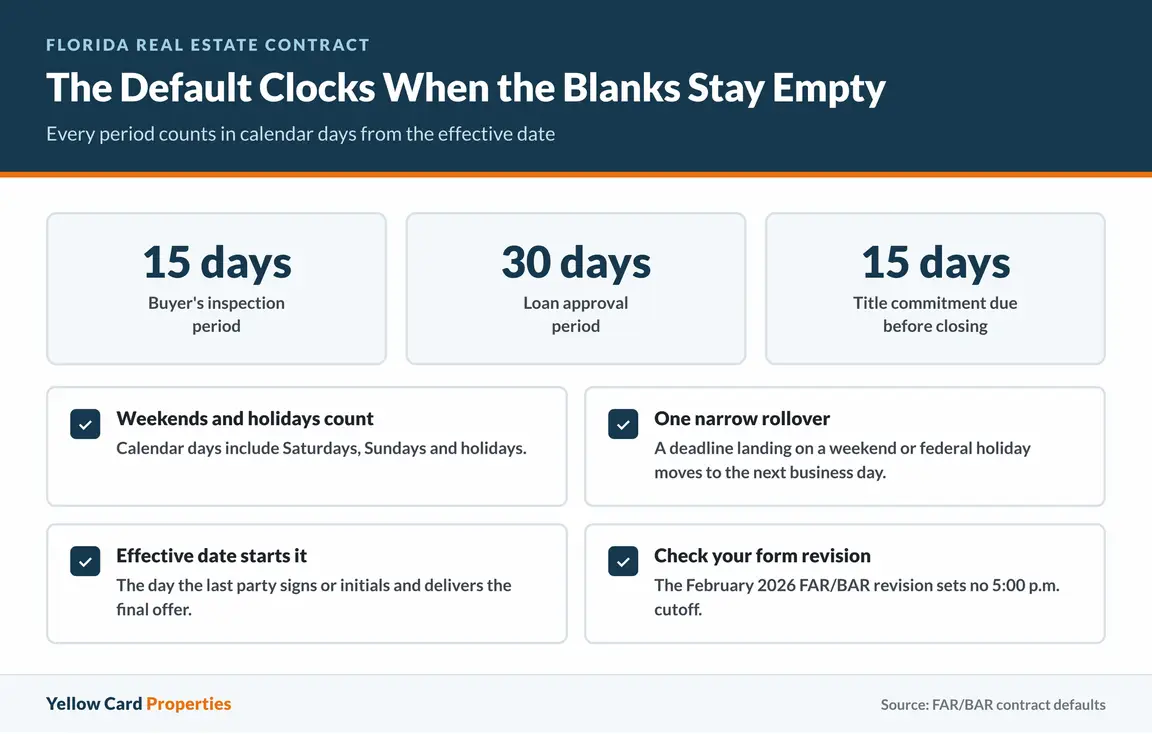
Weekends count. So does Thanksgiving. A hurricane evacuation order on a Tuesday in Pinellas County won’t stop the clock either. The FAR/BAR form says plainly that time is of the essence, and it uses calendar days, based on where the property sits, to compute every time period. Almost every date in the agreement runs on that one standard.
Now for the part that trips up even experienced agents. The form carves out one narrow exception to the calendar-day rule. When a deadline lands on a weekend or a federal holiday, it rolls forward to the next day that’s neither. That extension doesn’t apply to the effective date or to the time allowed for acceptance.
So where does the counting start? The effective date is the day the last party signs or initials the offer (or the final counter-offer) and delivers it. Everything downstream hangs off that one day. Miss it by 24 hours and every later deadline shifts right along with it.
Default windows exist too, for anyone who leaves the blanks empty. With no numbers filled in, the buyer gets 15 days to inspect, 30 days for loan approval, and the title commitment is due 15 days before closing. In practice, those fallback terms end up carrying more weight than the parties ever planned. I’d argue they’re the most ignored paragraph in Florida residential real estate.
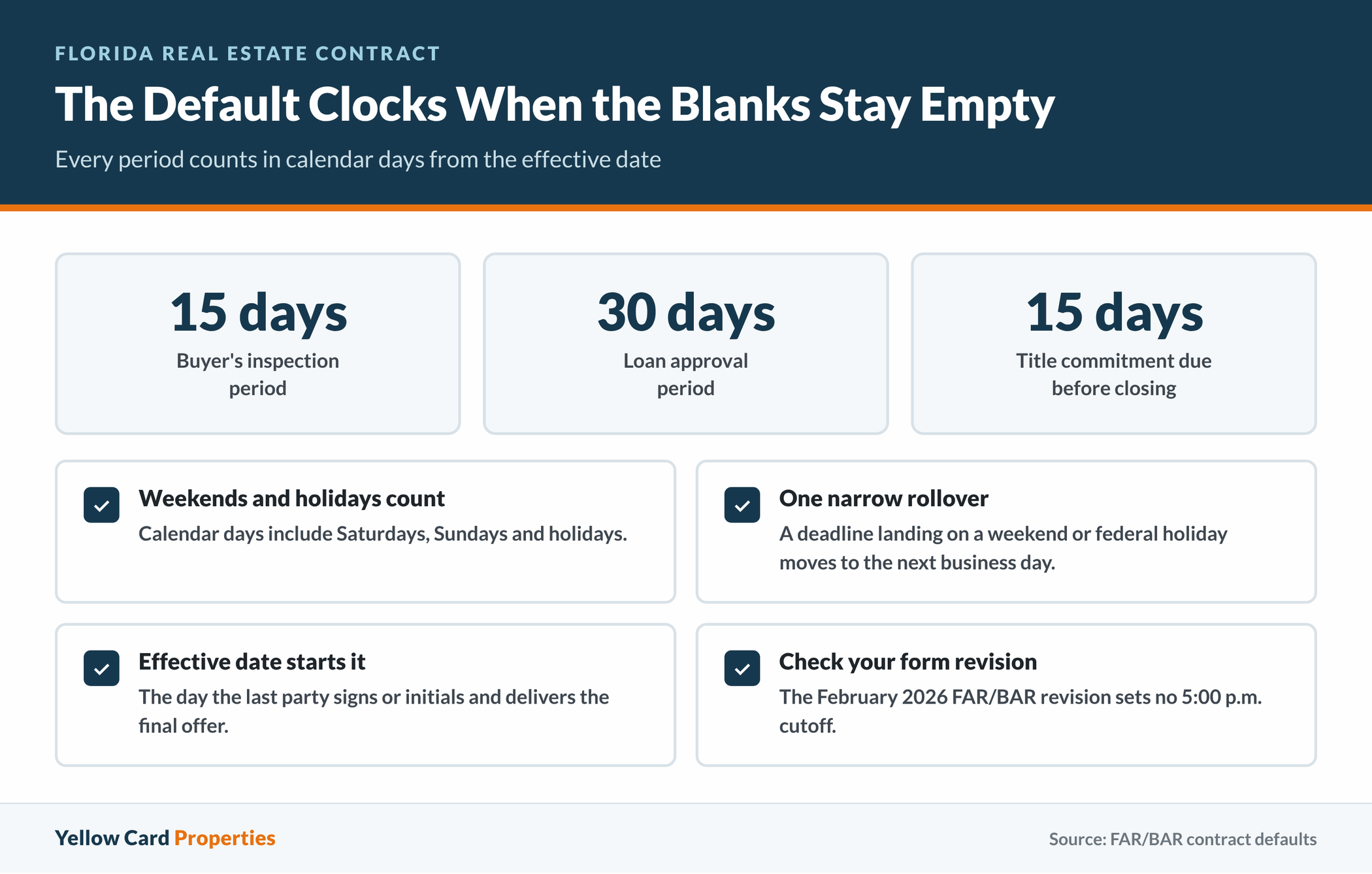
One more wrinkle is worth knowing before you sign anything. The February 2026 revision of the FAR/BAR form sets no 5:00 p.m. cutoff and no clock time for any deadline at all, and older versions some brokerages still hand out read differently. If your form came off a printer in a Sarasota or Ocala office a few years ago, check which revision you’re holding. Berlin Patten Ebling’s practice guidance covers the same ground for Florida practitioners.
Why Calendar Days Matter in a Florida Real Estate Contract
Say your buyer’s inspection window closes on a Sunday. You’ll find out Monday morning, whether you planned for it or not. I have this talk all the time with Florida homeowners who figure somebody will call them before anything happens.
Years back I worked with a family in Winter Garden that was splitting assets in a divorce. Neither spouse wanted the house, and neither wanted to manage showings. There was also a kayak rack bolted to the garage wall that nobody could agree on. That’s three problems before the sale even started. They wanted the sale handled and the calendar kept simple, so we set one closing date and worked backward from there.
A 15-day inspection period that starts on a Friday gives a buyer roughly ten working days once you take out the weekends. Inspectors in busy Florida markets book up before half that window is gone. A seller waiting on a repair request that never shows up has usually just watched the buyer’s objection right expire.
Good Florida title companies put every one of these dates on a calendar. If yours doesn’t send you a deadline sheet within 48 hours of execution, that tells you something about how the rest of your closing will go.
Cash transactions run on the same calendar-day math, with fewer boxes to check. Our team at Yellow Card Properties writes a real estate contract with no financing contingency, so the loan approval window and the appraisal timeline drop off the schedule entirely. I’ve seen that alone save a transaction when a lender dragged its feet. Fewer dates leave fewer ways for a Florida sale to come apart.
How Long Does a Real Estate Contract Last in Florida?
An heir in Port Charlotte called me about a house she’d inherited, screened lanai still full of her uncle’s fishing gear. Her listing agreement had expired and two buyers had walked away. She assumed the original agreement was somehow still alive. It wasn’t.
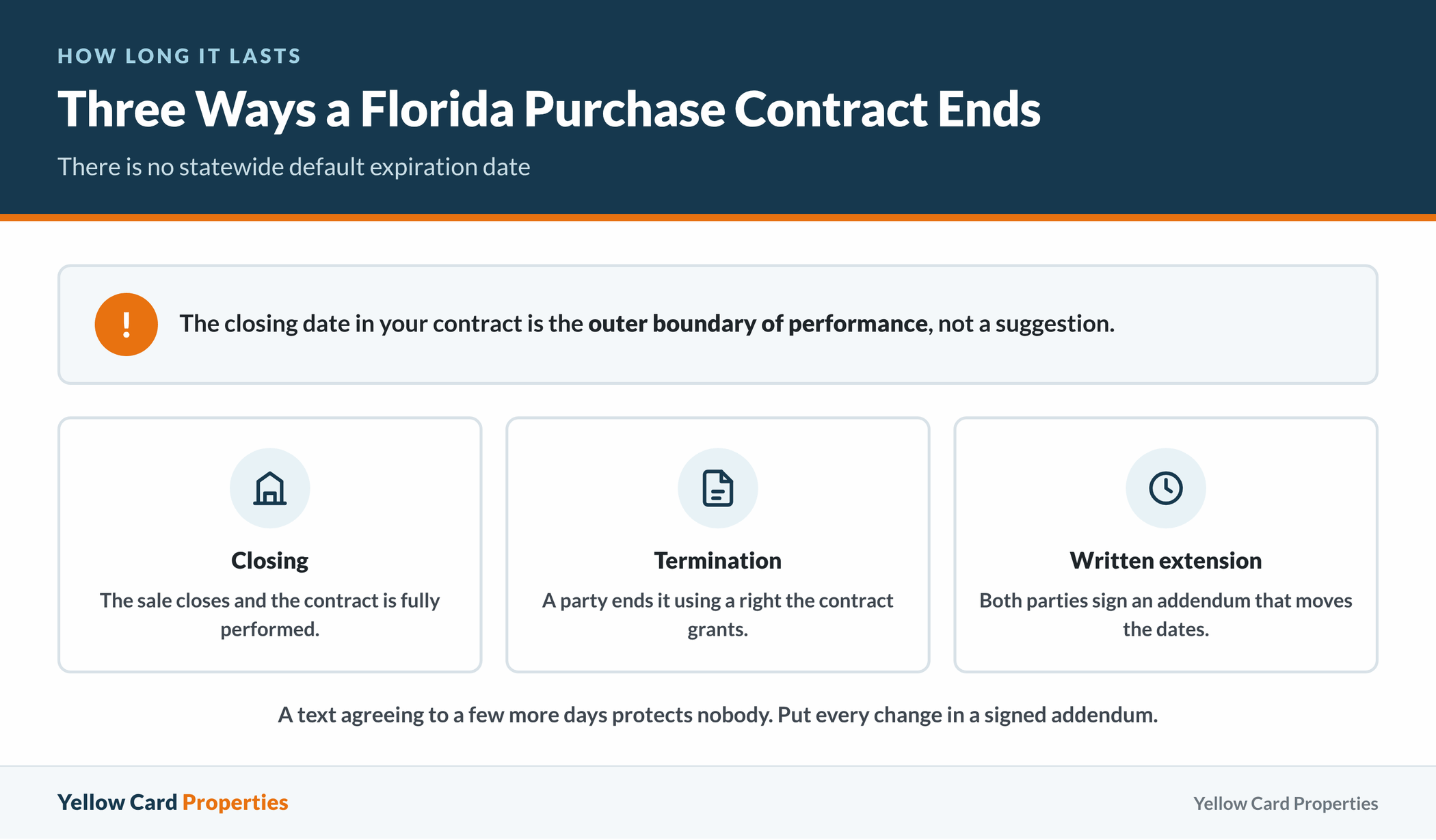
A Florida real estate contract lasts until closing, until a party terminates under a right the agreement grants, or until the parties agree in writing to extend it. There’s no statewide default expiration that covers every purchase agreement, so don’t go hunting for one. Treat the closing date in your document as the outer edge of performance. It isn’t a polite suggestion.
Usually, a realistic window tracks the pace of the market. Statewide, Florida listings took a median of 81 days in September 2026, down 8 percent from a year earlier, and roughly 20 percent of listings took a price cut. That’s listing-to-contract time, before you tack on 30 to 45 days of escrow.
The swings across the state are wide. Northeast Florida’s six-county median price edged up to $399,056 in October 2026, and homes that sold there spent a median of 36 days on the market. Daytona Beach looked nothing like that. Houses there took a median 84 days to go pending in the three months ending October 2026, nine days longer than the prior year. Same state, same month, and two very different clocks.
That’s why a listed sale in Florida often eats about four months end to end. A contract with a direct buyer shrinks that to weeks, since there’s no appraisal and no underwriter.
How Do Florida Laws Shape Real Estate Contract Timelines?
“If my buyer breaches, how long do I have to do something about it?”
Five years, if the agreement is written. Breach of a written contract in Florida carries a five-year limitations period under section 95.11(2)(b), and it accrues at the breach. Oral agreements get less time, four years under section 95.11(3)(j). A contract for property here has to be in writing to be enforceable anyway, so the five-year figure covers nearly every residential transaction.
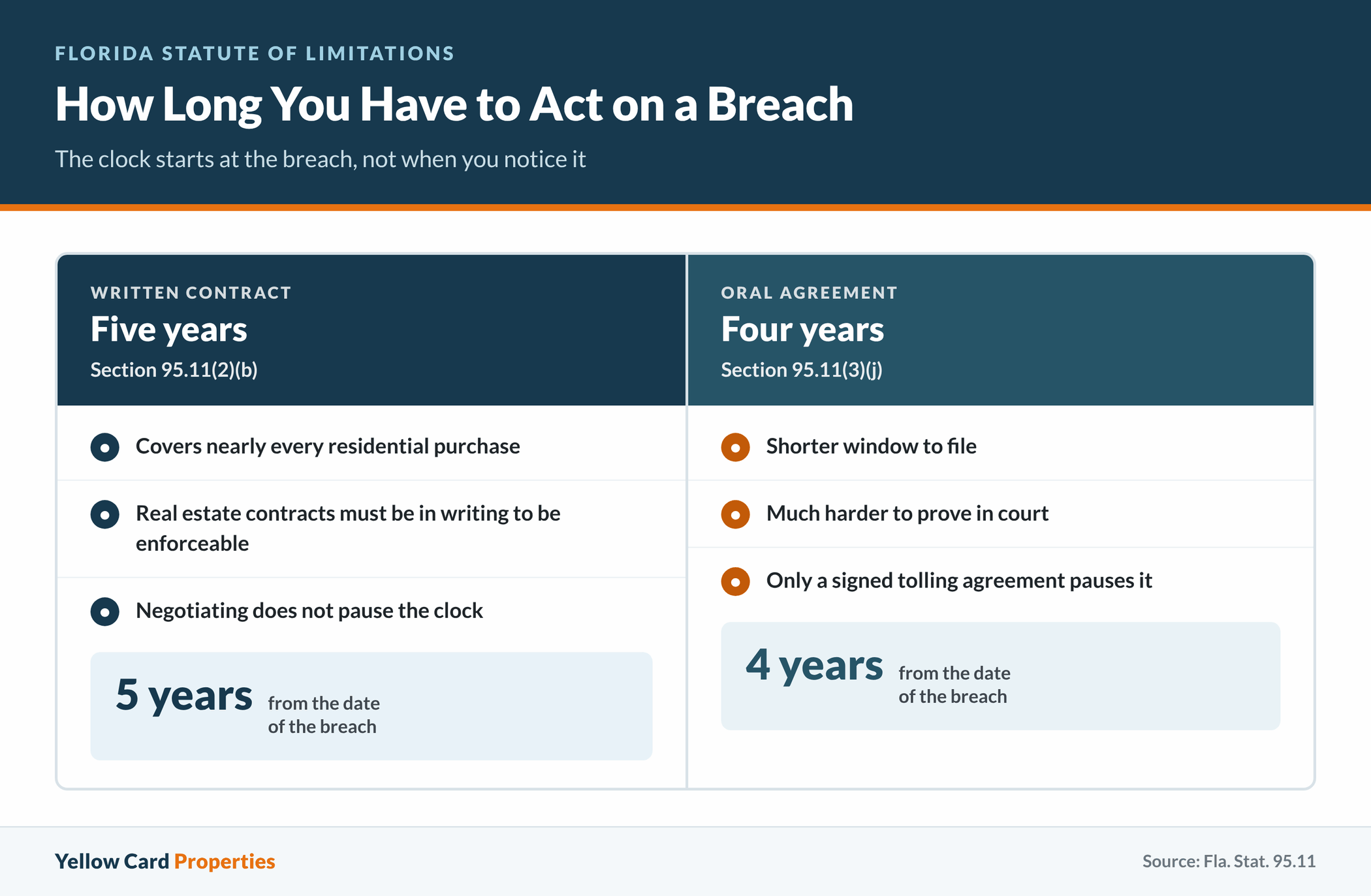
The clock starts at the breach. It doesn’t wait for the day you discovered it, or the day you finally got upset about it. Negotiating with the other side won’t pause that statutory window unless both parties sign a tolling agreement. A seller who spends two years trading emails with a defaulting buyer has burned two years of the five. You can read the limitations breakdown at Oldham Law’s Florida reference.
State law shapes the front end too. Statutory disclosure duties, condo and homeowner association document delivery, and lead paint rules on older homes all attach their own timing to it. Skip a required delivery and you may hand a buyer a termination right you didn’t know existed.
My advice to any Florida seller is short. Your contract rights and your statutory rights run on separate tracks. A Florida real estate attorney can confirm which deadlines apply to your specific agreement, and that call costs far less than the alternative.
What Does “Time Is of the Essence” Mean in a Real Estate Contract?
Under this clause, missing a deadline by one day can hand the other side a termination right plus a claim on the escrow deposit. Nobody’s trying to scare you. That’s simply how the language works in a Florida contract.
Both the FAR/BAR Standard form and the AS IS form say time is of the essence, so neither one forgives a missed deadline. The phrase turns every date into a material term. In contracts without it, a court might call a short delay immaterial and order performance anyway.
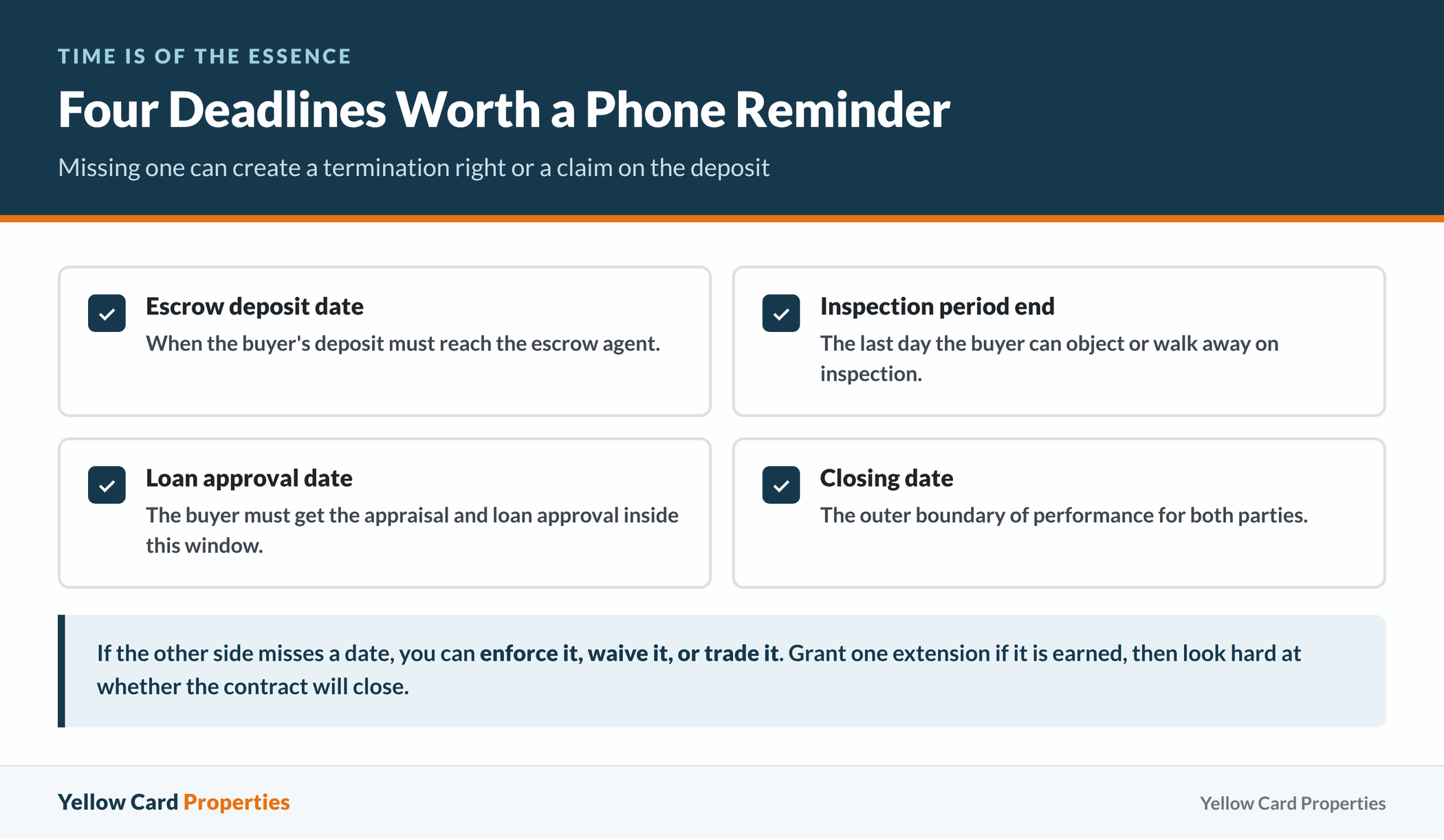
Four deadlines deserve a reminder on your phone: the escrow deposit date, the end of the inspection period, the loan approval date, and closing. Knowing the inspection period, the loan approval period, and the escrow deposit deadline is where your contractual exposure lives.
Some Florida agents treat a missed deadline as a negotiating hassle rather than a breach. I disagree with that read. Once the clause is in your contract, the other party gets to choose whether to enforce it, and plenty of buyers do when the market gives them a reason.
Is your closing date realistic for your lender? Ask before you sign, not two weeks out.
Extensions are the practical fix, and they must be written and signed by both parties. A text agreeing to “a few more days” won’t protect anybody in a Florida contract dispute. An addendum costs nothing and settles the question.
What Happens When a Real Estate Contract Deadline Is Missed?
Plenty of sellers tell me a missed date kills the whole thing. It usually doesn’t. A missed deadline in a Florida contract gives the non-breaching party an option, and that party decides whether to enforce it, waive it, or trade it for something.
Picture your buyer’s loan approval date coming and going without a word. Under the current FAR/BAR structure, the burden sits with the buyer, so the buyer has to get the appraisal done and the loan approved inside the contract’s window to protect the deposit. A Florida seller in that spot can demand the deposit, agree to an extension, or hold firm on the original closing date.
Deposits are where it gets real. Escrow agents in Florida can’t release funds on one party’s say-so once there’s a dispute. They follow the contract’s procedures, and if that fails, they interplead the money into court. Waiting months for a few thousand dollars isn’t unusual.
Buyers face consequences as well. A buyer who blows through the inspection period and then tries to terminate has often turned a refundable deposit into a forfeited one.
What I keep seeing from Florida sellers is a reluctance to say no. Somebody misses a date, apologizes, and asks for a week. The seller agrees to a third extension because starting over feels worse. Repeated waivers can weaken your position later. Give one extension if the buyer’s earned it, then look hard at whether this buyer is going to close at all.
What Should Buyers and Sellers Know About Real Estate Contract Deadlines?
Sign the papers, wait for the title company to call, show up at closing. That’s the picture most people carry, and it falls apart the first time a Florida buyer’s insurance estimate comes in above the lender’s number. In coastal Florida, insurance pricing has derailed more closings over the last three years than appraisals have.
Condo buyers carry an extra timing load. Association documents, reserve studies, and milestone inspection reports on older Florida buildings all have to fit inside the contract’s schedule. A slow association can eat a week.
South Florida numbers show how much room there is to negotiate timelines right now. Over the twelve months ending in September 2026, 77 percent of Broward sales and 80 percent of Palm Beach sales closed below list price. Sellers in that position have leverage on dates, and on more than dollars.
Price your deadlines the way you price your house. A 45-day closing on a Jacksonville property with a conventional loan is tight but doable. Put that same timeline on a Keys property with flood zone complications and it’s wishful thinking.
A man in Palm Bay called me one Wednesday afternoon holding a contractor’s estimate for a full kitchen gut. It ran past anything the kitchen would add to his sale price. He’d sat on that number for a month, afraid to list. We talked through what a contract with no repair obligation would look like, and I could hear his shoulders drop. He didn’t need a renovation. He needed somebody to take the house as it stood.
If you’re looking at a Florida real estate contract and aren’t sure what you’ve agreed to, we’re glad to walk through it with you. The same goes if you’d rather skip the deadline gauntlet with a plain cash sale. There’s no pressure and no obligation, and no hard feelings if listing turns out to be the better path for your house.
Frequently Asked Questions
Can a Seller Back Out of a Real Estate Contract in Florida?
Only if the agreement gives you a way out or the buyer breaches first. A Florida real estate contract binds the seller just as firmly as the buyer, and a buyer who wants the house can sue for specific performance to force the sale. Cold feet aren’t a termination right. Talk to a Florida attorney before you tell anyone you’ve changed your mind.
Can You Extend a Real Estate Contract in Florida?
Yes, as long as both parties put it in writing. An addendum can push back closing or stretch the inspection period, and anything it doesn’t mention stays as it was. A verbal yes won’t hold up if the other side disputes it later. Once it’s final, ask your Florida title company to update its timeline so nobody’s working from the old schedule.
How Long Do I Have to Sue Over a Breached Real Estate Contract in Florida?
Florida’s limitations period for written contracts governs most purchase agreement disputes. It runs from the date of the breach, not the date you noticed it. Partial performance and certain conduct can change when that clock starts, so the date on your calendar might not be the date a court uses. Bring the signed contract and every piece of correspondence to a Florida attorney early, not in year four.
Do Written Contracts Actually Hold Up in Court in Florida?
They do, and that’s the whole reason Florida requires real estate agreements to be in writing. A signed real estate contract with clear terms, named parties, and a described property gives a Florida judge something concrete to enforce. Handshakes and verbal promises about closing dates get a shorter window and a much harder evidentiary road. Put every change in a signed addendum.
What Happens to the Deposit If a Florida Real Estate Contract Falls Apart?
Your escrow agent follows the dispute steps written into the real estate contract. That usually means written demands, a waiting period, and then mediation or a court filing. Neither party can just call the title company and claim the money. Agreeing in writing to a mutual release is almost always faster and cheaper than letting a Florida court sort it out.
What Jacksonville’s Market Means for Your Contract Timeline
Homes around Jacksonville and Orange Park aren’t moving fast right now. Metro listings sat a median of 66 days in October 2026, the same as in September. Add 30 to 45 days of escrow, and a listed sale can easily run past three months.
We buy houses from homeowners across Florida, and a cash contract has no loan approval date or appraisal window to track. You’ll have fewer deadlines to watch and one closing date you pick yourself.
Talk Through Your Florida Contract With Us
Not sure how much time is left on your contract, or whether a cash sale would be simpler? Reach out to Yellow Card Properties and we’ll go over your dates with you. There’s no obligation, and you can use the form below to tell us about your house.