
Four months after a funeral, most families I meet are still paying for a house nobody lives in. Insurance, taxes, lawn service, a pool that turns green in August. The estate keeps bleeding while everyone waits on a court file number, and the money drains out long before anyone signs a contract. Selling a probate house in Florida doesn’t have to crawl, but the delays are rarely where people look for them.
What Is Probate Property in Florida?
A daughter called me from Tampa about her father’s place in Ocala. He’d been gone six weeks, the will named her, and she figured she could sign a deed that day.
Probate is the court process that moves a dead person’s assets to the living. Say a Florida resident dies owning real estate in their own name. The house usually has to pass through probate administration before clean title can go to a buyer. No will? Same court, different path. The state’s intestacy rules decide who the heirs are.
Property held in joint tenancy with right of survivorship passes to the surviving joint tenant without the court. Same with a living trust, or a lady bird deed naming beneficiaries.
What makes a probate house different from any other local listing is who holds the pen. Title vests in the beneficiaries at death, but the personal representative controls the property and signs on its behalf. So you may own a piece of the house and still have no power to sell it.
Here’s where the daughter got stuck. She had to wait for the judge to appoint her before her signature meant anything. Once her letters came through, the sale itself moved quickly.
Probate also sorts out debts before heirs see a dime. Creditors, medical bills, the mortgage and liens all get handled first.
What Are the Legal Requirements for Selling a Probate House in Florida?
“My brother’s the executor, so he can just sell it.” Not quite. He has no legal power over the house until the circuit court appoints him and issues Letters of Administration. After that, a personal representative can list and sell estate real property.
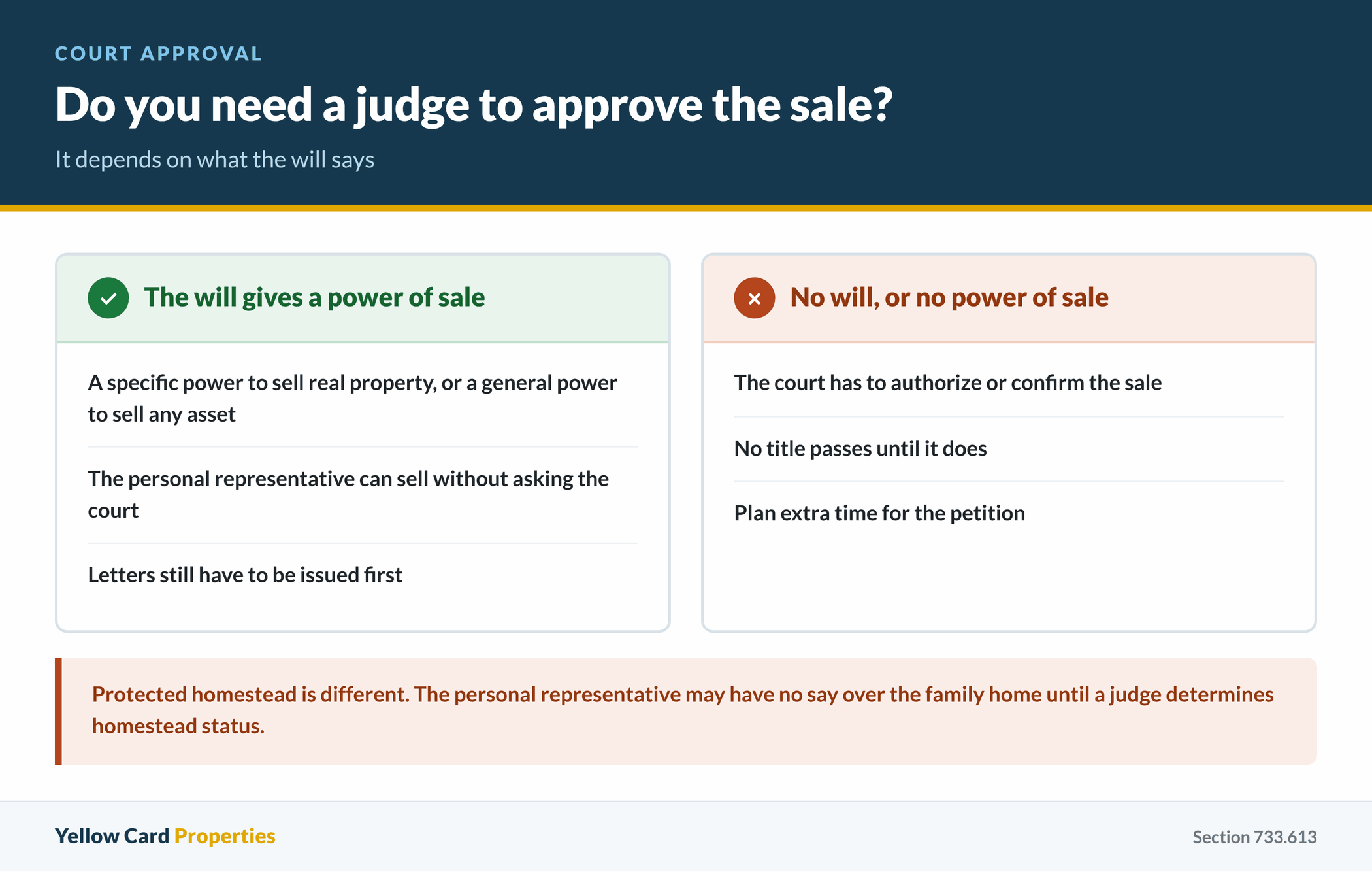
Whether you need a judge’s blessing on the sale itself depends on the will. If the will gives a specific power to sell real property, or a general power to sell any estate asset, the personal representative may sell without asking the court. Plenty of Florida wills include that clause.
No will, or a will without that power? Then the court has to sign off. There’s no wiggle room in the statute. No title passes until the court authorizes or confirms the sale, and you can read the text yourself in section 733.613 of the Florida Statutes.
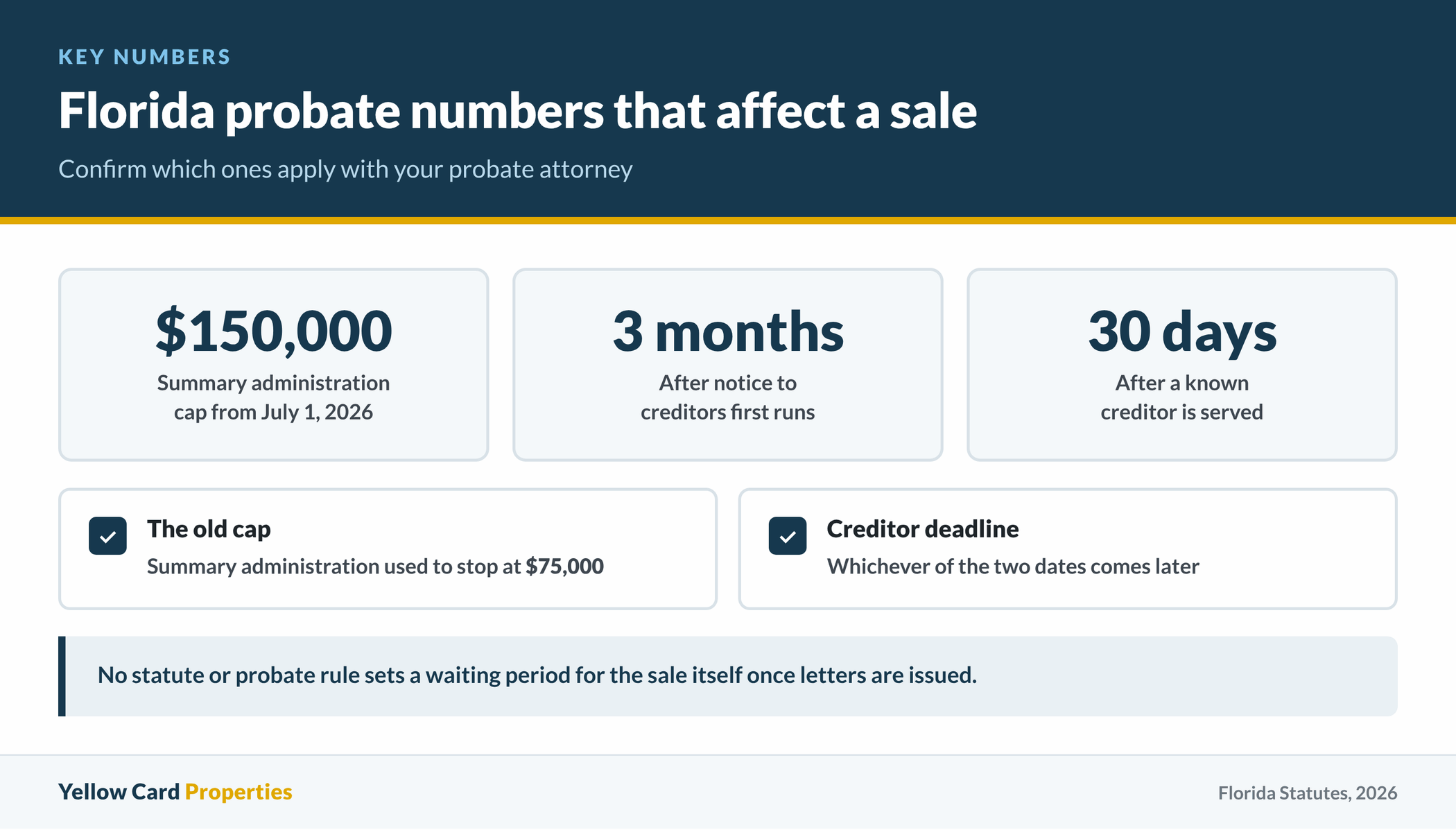
Creditors get their window too. They generally have to file a claim by the later of two dates. One is three months after the notice to creditors first runs in the paper. The other is 30 days after a creditor who had to be served gets served. You’ll find the deadline in section 733.702.
Small estates clear probate faster. Florida raised its summary administration cap from $75,000 to $150,000 on July 1, 2026, according to the Florida Senate’s bill summary. Your probate attorney can tell you in one phone call which limit fits your situation.
Does Florida’s Homestead Law Affect Your Probate House Sale?
Florida’s homestead rules change who can inherit the family home and who can sell it.
Homestead property gets more protection in Florida than in almost any other state. If a spouse or minor child survives the owner, homestead can’t be left to someone else by will in most cases.
That protection cuts both ways here. Homestead and other property that creditors can’t reach are left out of the summary administration cap entirely.
The personal representative’s power also shrinks. Each personal representative takes control of the decedent’s property except the protected homestead. So the executor who can sell a Florida rental condo tomorrow may have no say over the family home. Nothing moves until a probate judge enters an order determining homestead status.
It’s the most common bottleneck I see in probate sales, and it often sits undone because nobody told the family to ask.
Title underwriters will not insure around it. Every buyer’s closing agent wants that order in the file, and without one, the house sits. We at Yellow Card Properties run into this regularly across Jacksonville and the surrounding counties. The fix is almost always speed on the legal side, not the property itself.
Can You Sell a Probate House Before Probate Closes?
Yes.
You can sell a house that’s still in probate, and probate doesn’t have to be finished first. Holding it until final distribution is one of the worst financial choices a family can make. Carrying costs will keep running, and Florida’s insurance market is hard on vacant homes.
Timing works like this. Once letters issue, the personal representative can market the property, accept an offer and close. The creditor period and the accounting keep going in the background.
Sellers get stuck when they assume the court sets a waiting period before a sale. Neither section 733.613 nor Probate Rule 5.370 sets a waiting period for the sale itself.
Empty houses break down fast here. A shut-off AC in a Jacksonville summer can mean mold on the drywall in weeks, and roof age alone can make a house uninsurable for a regular buyer. I’ve walked into inherited houses in Palm Coast where nine months of sitting cost the family more than the repairs would’ve.
One caution. Don’t sign a listing agreement before letters are issued, because the agent can’t bind an estate that has no appointed representative yet.
How Do You Sell a Probate House in Florida, Step by Step?
$420,000 was the median Florida single-family sale price in October 2026, according to Florida Realtors. That’s the number your property gets measured against, and getting there takes a set order of steps.
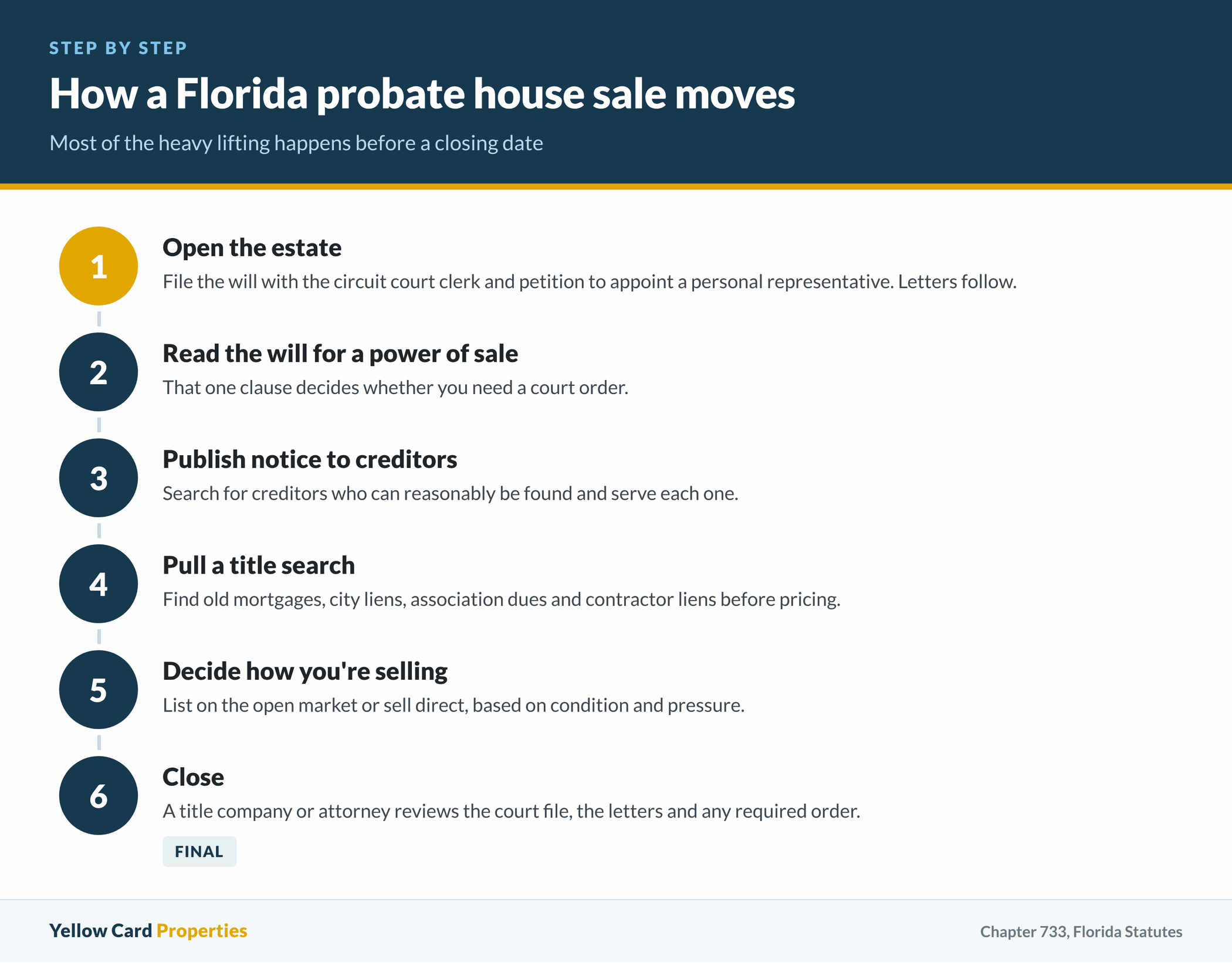
Open the estate first. File the will, if there is one, with the circuit court clerk in the county where the decedent lived. Then petition for administration and get the personal representative appointed. Letters follow.
Second, read the will for a power of sale. You can tell from that one paragraph whether your Florida property needs a court order or can go straight to market.
Third, publish notice to creditors and run the diligent search the statute requires. The personal representative must promptly search for creditors who can reasonably be found and serve each one a copy of the notice.
Fourth, pull a title search before you price anything. Look for old mortgages, code enforcement liens from the city, unpaid association dues, or a contractor’s lien from an old roof job. Find them now.
Fifth, decide how you’re selling. Listing a probate house on the open Florida market makes sense when the property shows well and the family isn’t under financial pressure.
Closing comes next. A title company or real estate attorney handles the closing on a probate house, reviewing the court file, the letters and any required order. Most of the heavy lifting happens before you ever see a closing date. Chapter 733 of the Florida Statutes covers most of what happens between those steps.
What Challenges Come Up When Selling a Probate House, and How Do You Solve Them?
Four siblings agree the house should go. Three weeks later, one of them stops returning the attorney’s emails because she’s decided the price is too low and she grew up in that bedroom. So the probate house doesn’t sell.
Fights among heirs hold up more Florida probate sales than any legal detail.
Condition is the second wall. Probate houses tend to be older, often owned by someone who stopped keeping things up during a long illness. Think polybutylene plumbing, a 1990s electrical panel or a roof past insurable age.
Then there’s time on market. Realtor.com data on the St. Louis Fed’s FRED site put Florida’s median listing at 81 days on market in September 2026. Stack that onto a 30-day closing and you’re looking at nearly four months of estate carrying costs.
Out-of-state heirs make probate harder. A daughter in Ohio managing a probate house in Orange Park can’t meet inspectors, sign at a Florida closing table on short notice, or run a cleanout.
Many carriers here won’t write a vacant home policy on an empty probate house past a certain point. An uninsured property near the coast in hurricane season is a risk no estate should carry.
Why Do Cash Buyers Make Sense for a Florida Probate House Sale?
One heir in Gainesville watched a financed buyer’s loan fall apart three weeks before closing, and it set the estate back by months. A financed buyer is the wrong buyer for most probate houses in Florida, and estates learn that lesson the hard way.
The roof gets flagged by an appraiser and the underwriter demands repairs. Now the estate is asked to pay for a new roof on a house it’s trying to sell off.
Cash buyers remove the appraisal, the loan contingency and the repair demands. Real estate investors who work Florida probate regularly also read Letters of Administration without panic. That sounds minor until you’ve watched a retail buyer’s agent get spooked by the word “estate.”
Speed changes the math on one of these. Northeast Florida Realtors reported that Clay County homes took a median of 48 days to sell in September 2026, and St. Johns County homes took 42. Those homes were in sellable shape, so a dated probate house with deferred upkeep does worse.
Any cash offer on a probate house comes in under full retail value, because the buyer takes on the repairs, the holding risk and the unknowns behind the drywall.
One closing date, no financing fallout, no second buyer after the first one walks. Yellow Card Properties handles Florida probate sales this way regularly and closes on the estate’s timeline instead of a lender’s.
How Much Do Realtor Fees Really Cost You on a Probate House?
Estate sales carry a cost line that ordinary sales don’t: the personal representative’s own pay, which Florida law ties to the estate’s value. When the probate estate is worth $100,000 or more and two representatives serve, each one can take the full commission a sole personal representative would get.
Agent fees come next. The listing commission and any buyer’s agent fee both come out of the sale price, and what a Florida realtor charges varies by agent and by listing. On a mid-range home, that’s real money leaving the estate.
Closing costs add more. You’ll see documentary stamp tax on the deed, title insurance, recording fees and prorated taxes. Sellers here usually cover doc stamps and, in most counties, the owner’s title policy, though both can be negotiated.
The probate side has its own bills. There are attorney fees, court filing costs with the clerk, and the cost of running the notice to creditors in a local legal paper. Some estates also pay for an appraisal for the inventory.
Then come the holding bills. Property taxes and a pricey vacant home policy keep running. So do power for the AC, lawn service and pool chemicals. Three or four months of that on a probate house adds up to a sum that tends to surprise families at the final accounting.
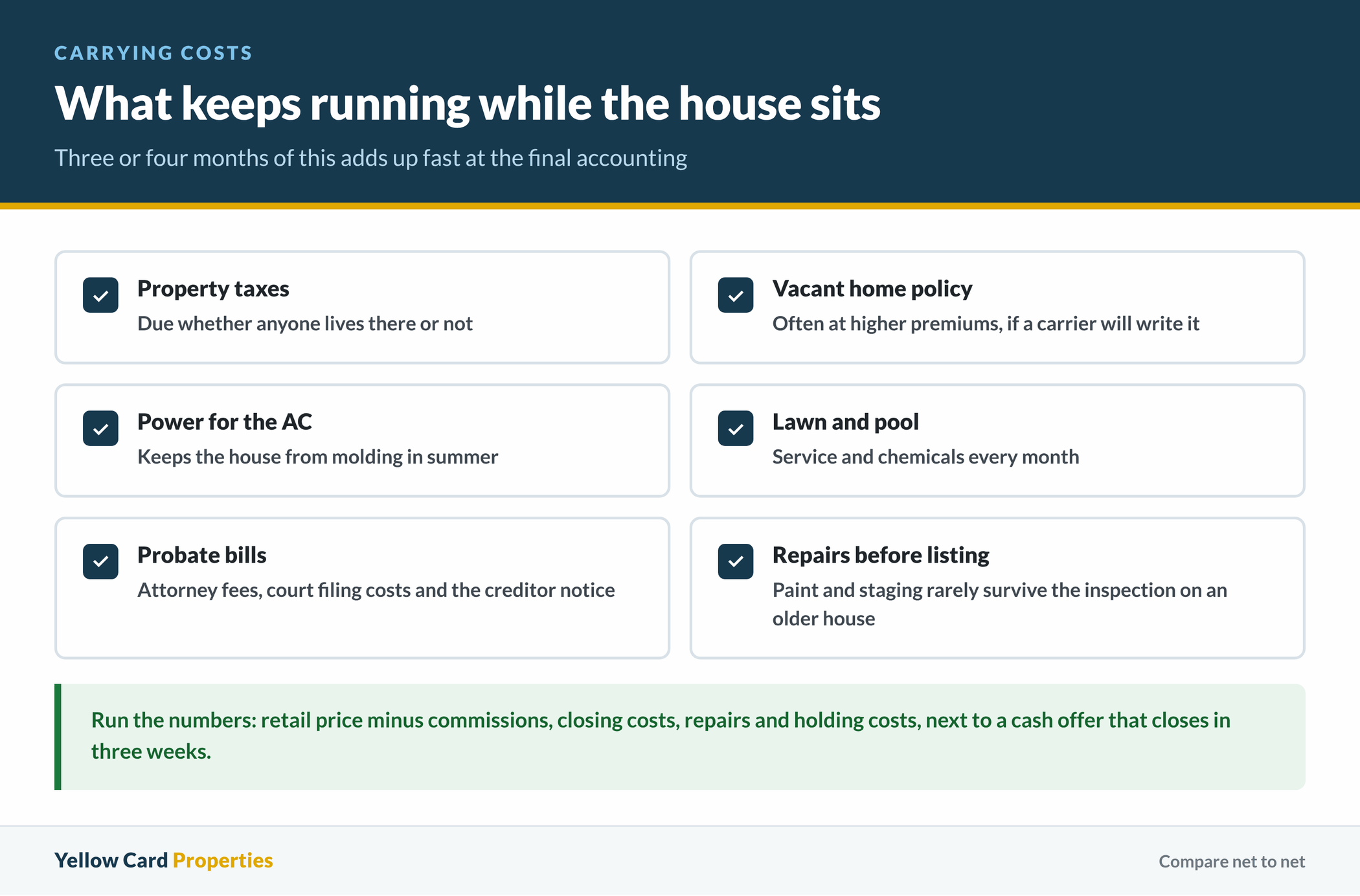
Agents often tell estates to spend on paint, flooring and staging before listing a probate house. For a clean, updated Florida home in a desirable neighborhood, fine. On a 1974 ranch in Palatka with a twenty-two-year-old roof, you’re spending estate money on looks that won’t survive the inspection report.
Run the numbers honestly. Take the likely retail price and subtract commissions, closing costs, repairs and four months of holding expenses. Compare that net against a cash offer that closes in three weeks with none of those deductions. Often the gap between the two net figures is small, and now and then the cash price comes out ahead.
A seller in Fernandina Beach reached me on a Thursday. He’d fallen behind on the mortgage he’d inherited along with his mother’s house, and an auction date was already on the county calendar. We closed before the sale date, the lender got paid, and he kept the equity a foreclosure would have swallowed whole.
Frequently Asked Questions About Selling a Probate House in Florida
What Are Florida’s Probate Rules for Homestead Property?
Homestead gets treated as its own category under state law, separate from the rest of the estate. If a surviving spouse or minor child exists, the state constitution controls who receives the property, whatever the will says. Your probate attorney usually files a petition asking the judge to determine homestead status. Most Florida title companies want that order in the file before they’ll insure the sale.
How Long Does It Take to Close an Estate After Probate in Florida?
Formal administration usually takes many months for a simple estate. It runs longer when heirs disagree, assets sit in more than one state, or a creditor fights something. The creditor claim window described earlier sets the floor, since the personal representative can’t safely pay out heirs before it ends. Selling the house doesn’t have to wait for any of that. It’s why so many Florida families sell the real estate early and let the paperwork finish on its own schedule.
How Much Does a Simple Probate Cost in Florida?
Costs change by county and by attorney. Florida law lets attorney pay be set as a reasonable fee or figured against estate value. Simple summary administration with no real estate problems costs far less than a full one. Formal administration with a probate house, creditor claims and a homestead ruling runs much higher. Ask for a written fee agreement up front, and ask the clerk of court in your county for the current filing fees before you budget.
Can Heirs Force the Sale of a Probate House in Florida?
When co-heirs can’t agree, Florida law offers a partition action that asks a court to divide the property or order it sold, with the proceeds split. It’s slow, it’s expensive, and it tends to cost more than the fight was ever worth. Mediating through the probate attorney before anyone files is almost always the cheaper path. A direct sale to one buyer at a price everyone can live with ends the standoff faster than a lawsuit does.
Do You Have to Make Repairs Before Selling a Probate House?
Not if you sell as-is, and most estates shouldn’t pour money into a house they’re selling off. State law still requires sellers to disclose known defects that a buyer can’t easily see. A personal representative who never lived in the probate house usually has little to disclose. Buyers who pay cash for estate property expect condition issues and price for them, so you’re not hiding anything by skipping the remodel.
Does a Probate House in Florida Have to Be Listed with a Realtor?
No. Any personal representative with proper authority can sell straight to a buyer without ever putting the probate house on the MLS. Listing makes sense when the property shows well and the estate can wait out the marketing timeline. A direct sale makes sense when the house needs work, the heirs are scattered, or the carrying costs are eating the inheritance.
Probate House Sales Around Jacksonville, Florida
Most of the estates we work with sit in Northeast and North Central Florida. The six-county Northeast Florida region posted a median single-family price of $399,000 in September 2026, according to Northeast Florida Realtors, so a dated probate house there usually trades below that line. For a house farther out, here’s where we buy houses in Florida.
Talk Through Your Florida Probate House With Us
If you’re sitting on a probate house somewhere in Florida and you’re not sure whether to fix it up, list it or just be done with it, we’re glad to talk it through. No pressure, no obligation, and no hard sell if a regular listing turns out to be your better move. Whenever you’re ready, even months from now, contact Yellow Card Properties or use the form below.