
A clean-looking house can hide a messy paper trail. I’ve walked through homes in Port Charlotte that photographed beautifully. Then the title search came back with a dead contractor’s lien and an ex-spouse still named on the deed. Title issues don’t announce themselves. They sit quietly in the county records until a buyer’s closing agent pulls the chain of ownership apart. If you own property in Florida and something feels unsettled about who holds legal title, you’re not stuck. You just need to know what you’re up against and what your real choices are.
What Are the Most Common Title Issues in Florida?
One seller in Cape Coral thought she owned her late mother’s house outright. The title search turned up three siblings with equal ownership rights, and none of them had signed anything in eleven years.
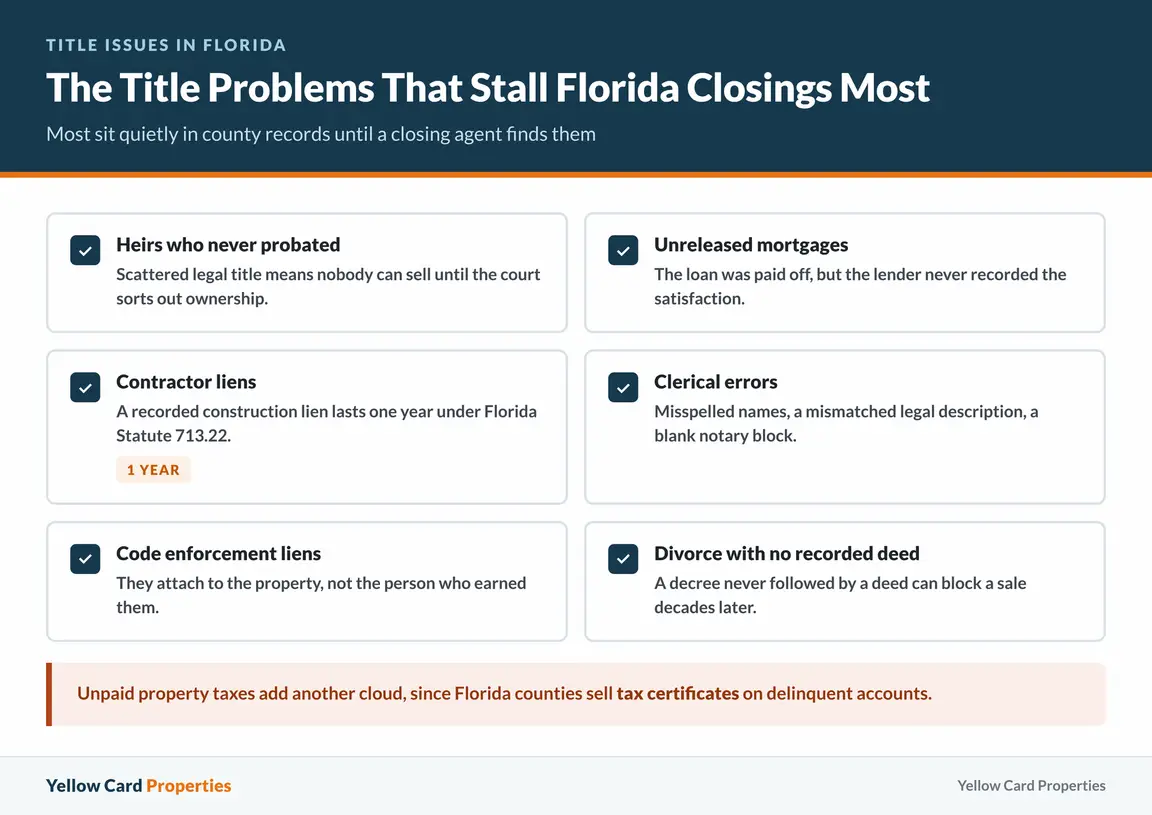
That story repeats in Florida more than almost any other, and I’ve seen it stall closings for months. Heirs who never probated an estate end up with scattered legal title, and nobody can sell until the court sorts out who owns what. Unreleased mortgages come second. A loan got paid off in 2003, the lender never recorded the satisfaction, and the lien still shows against the property.
Contractor liens are their own category in Florida, especially after hurricane seasons, when roofers and remediation crews flood neighborhoods from Fort Myers to Panama City. A recorded construction lien lasts one year from the recording date under Florida Statute 713.22. If the lienor never files a foreclosure lawsuit inside that year, the lien expires. A closing agent will still flag it.
Then there’s the clerical stuff: misspelled names on deeds, a legal description that doesn’t match the survey, a notary block left blank in 1987. Boundary disputes pop up often in older Florida platted subdivisions, where a neighbor’s fence or dock has crept onto your parcel. Code enforcement liens attach to the property rather than the person who earned them, and cities across Florida record them aggressively.
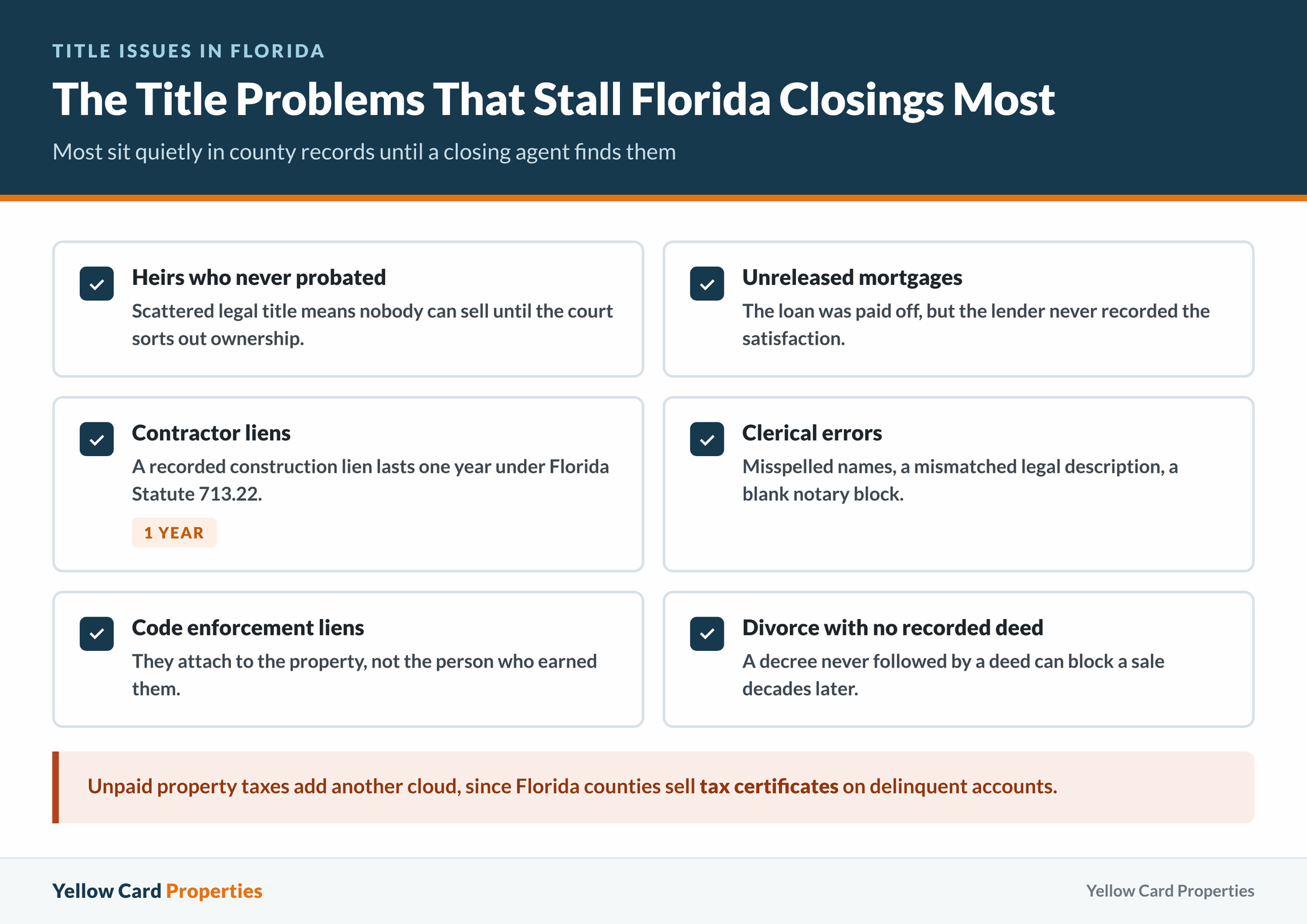
Unpaid property taxes are another common cloud sellers create, since Florida counties sell tax certificates on delinquent accounts.
Divorce decrees never followed by a recorded deed are the sleeper problem. Twenty years later, that’s a title issue blocking a sale.
How Do Title Issues Affect Your Closing Timeline?
“If my buyer’s already under contract, how long is this going to take?”
That depends entirely on which title issues turned up. An unreleased mortgage from a bank that got absorbed twice in the 2008 shuffle might take weeks of chasing a servicer’s lien release department. A probate matter in a crowded Florida circuit court runs months.
Now hold that against how fast the market moves. Across Broward County, the median home sold in 51 days during the twelve months ending September 30, 2026, and Palm Beach sat at 45 days. That’s listing-to-contract time, not the whole sale. Add roughly 30 to 45 more days for a financed closing, and your buyer’s patience runs out well before a probate judge gets to your file.
Buyers walk, and that’s the part that stings. A family with a lease running out and a mortgage rate lock ticking down won’t sit around while you untangle ownership rights from three decades back.
Lenders make it harder. No underwriter approves a loan while the title commitment carries unresolved exceptions, so your financed buyer can’t close even if they’d like to wait. Title insurance underwriters in Florida won’t issue a policy over an open cloud, and without a policy, the sale is dead.
Here’s something I’ve learned buying houses across Florida. Sellers almost always find out about title issues at the worst moment, right after they’ve emotionally committed to a closing date. Order the title search early. A good closing agent will run one before you ever list, and those few hundred dollars buy you a realistic calendar instead of a guess.
What Happens When a Title Error Shows Up at Closing?
One Thursday afternoon, a Lakeland widow sat down at the closing table expecting a check. Instead, a title error surfaced.
Closings in Florida stop cold when that happens. The title agent isn’t being difficult. The company insuring the transaction carries the liability, so it won’t fund over an unresolved defect. Your buyer’s lender pulls back, and escrow stays put.
What comes next depends on the contract you signed. Most Florida purchase agreements built on the standard Realtor forms give the seller a defined window to cure title defects. If you can’t, the buyer can terminate and recover the deposit. Read your specific contract, because that curative period varies by form and by what the parties negotiated.
Some title issues clear the same week. A payoff letter shows up, the second mortgage gets satisfied out of your proceeds, and everyone signs a day late. I’ve seen plenty of Florida closings survive a surprise lien that way, when the amount was small and the seller had the equity to cover it.
Others fall apart. Missing heirs, a forged signature in the chain, a judgment from a lawsuit the seller forgot about: those need a court, and courts don’t move on closing schedules.
The financial hit goes past the lost sale. Depending on your agreement, you may owe the buyer’s inspection and appraisal costs, and relisting after a failed closing invites questions. When a company like Yellow Card Properties buys a property, our closing team handles the title issues as part of the transaction. They don’t turn into your emergency to solve in fourteen days.
How Do You Fix Title Issues Before Listing Your Home?
Title searches in Florida aren’t standardized. That’s why a cheap search sometimes misses the very thing that kills your closing later.
Before anything else, get a full ownership and encumbrance report from a Florida title company. Request the chain going back at least thirty years, which is roughly the window Florida’s marketable record title framework treats as the root of title.
Gather your documents while you wait. Look for old satisfaction letters, divorce judgments, death certificates, probate paperwork, and signed contractor releases. I keep telling sellers this, and half of them don’t believe me until we’re in the middle of it. That shoebox in the closet often holds the exact piece of paper that resolves the title issues faster than a lawsuit could.
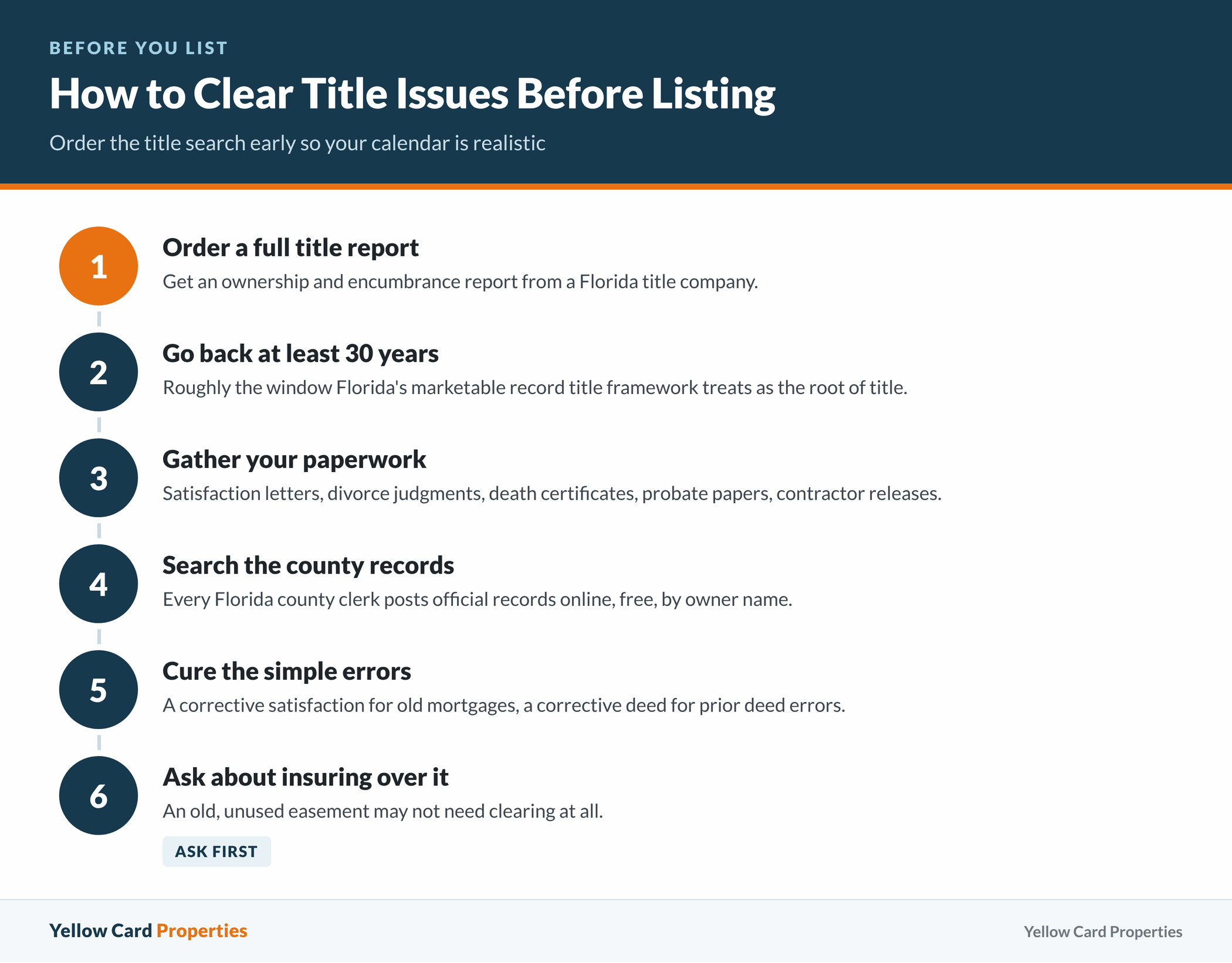
Every Florida county clerk posts official records online, searchable by owner name, and it’s free.
Unreleased mortgages usually get fixed by contacting the servicer and asking for a corrective satisfaction. If the bank no longer exists, your title company tracks down the successor entity. Simple errors in a prior deed get cured with a corrective deed signed by the original grantor. That carries a nominal recording cost rather than a transfer tax.
Say a sixty-year-old easement runs along a side lot line and nobody’s used it since Eisenhower. Your title underwriter may insure over it. Ask before you spend money clearing title issues that aren’t actually blocking anything.
What Legal Steps Resolve Title Issues in Florida?
Recording a quitclaim deed from the person causing the problem sounds like the obvious fix. It works well when that person is alive, willing, and easy to reach. It does nothing when the cloud comes from an unknown heir, a defunct corporation, or a lienholder who vanished in 1994.
A quiet title action covers those cases. Filed in Florida circuit court, a quiet title lawsuit asks a judge to declare who holds clear, marketable title. People use it for breaks in the chain of title, competing lien claims, errors in past foreclosures, and other clouds blocking a sale. The governing law sits in Chapter 65 of the Florida Statutes, mainly sections 65.011, 65.021, and 65.061, and you can read it in the Florida Senate’s statute database.
One limit to know before you hire anyone: the quieting title statutes don’t award money damages to you. If you want compensation from whoever made the mess, that’s a separate case.
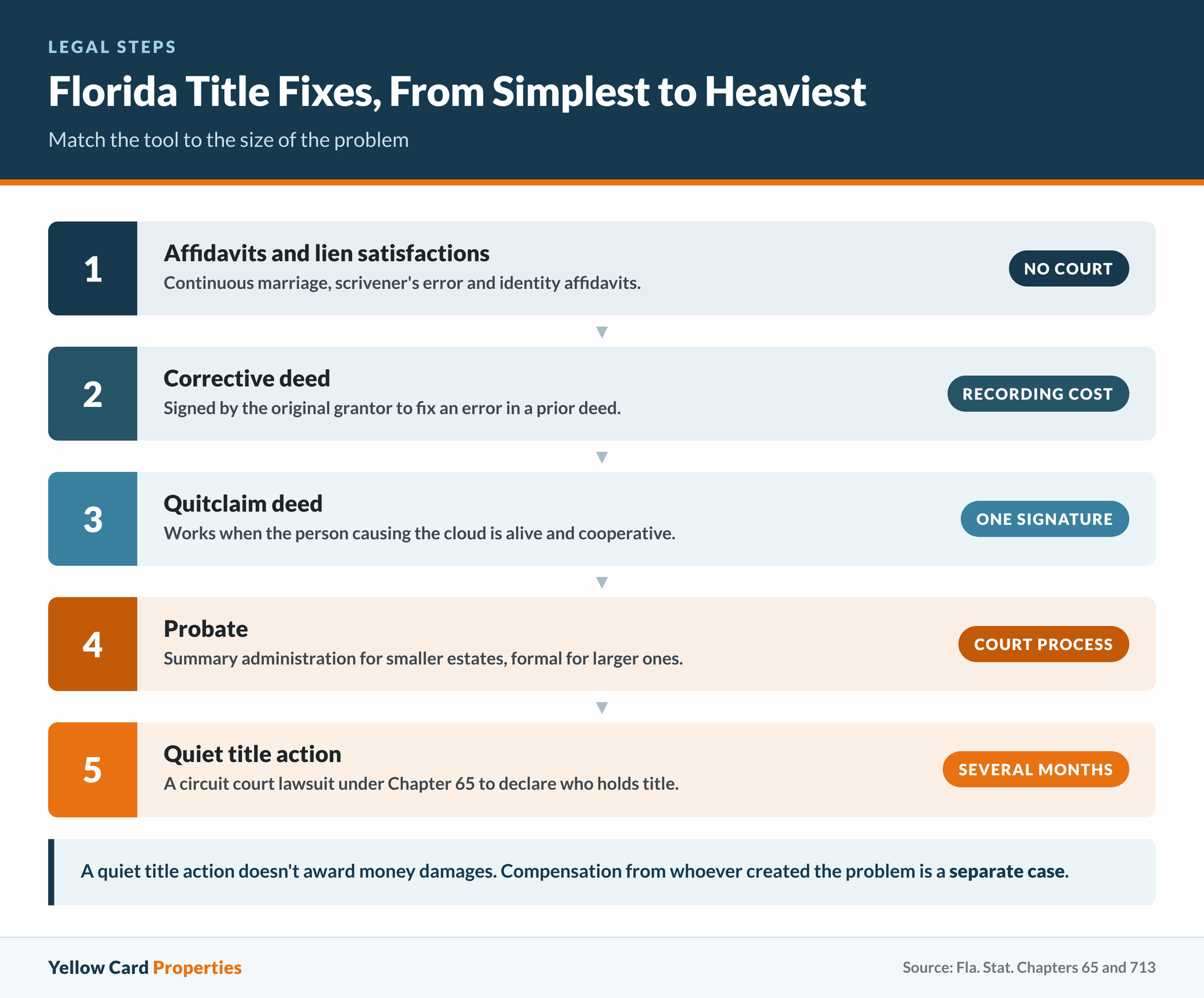
Probate is the other heavy lift. Smaller estates in Florida qualify for summary administration, while larger or messier ones need formal administration. Get the thresholds and procedures from a Florida probate attorney or your county’s clerk of court, not from an article.
Smaller tools handle smaller title issues. Affidavits of continuous marriage, scrivener’s error affidavits, and lien satisfactions fix a surprising share of Florida title defects without a courtroom. A contractor lien that’s run past its enforcement window can often be removed through the statutory discharge steps in Chapter 713, which you’ll find in the Florida Legislature’s online statutes.
A Florida real estate attorney who handles title litigation every week will resolve your situation faster than a general practitioner. The gap in legal fees is usually smaller than the gap in months.
How Much Does It Cost to Clear Title Issues?
“Why should I spend thousands on lawyers when I’m trying to get money out of this house?”
The cost of clearing title issues in Florida runs anywhere from a recording fee of a few dollars per page up to a quiet title action. The quiet title route brings attorney fees, service costs, publication for unknown defendants, and court filing charges. Those filing and recording amounts change, so your county clerk’s office can give you current figures before you commit.
Taxes, insurance (and Florida insurance premiums are brutal right now), lawn service, and electricity to keep the humidity down all keep coming. That carrying cost runs every month the title issues sit unresolved.
Florida charges documentary stamp tax on a deed at 70 cents for each $100 or portion of $100 of consideration in every county except Miami-Dade. Miami-Dade’s rate is 60 cents per $100 plus a 45-cent surtax that doesn’t apply to transfers of a single-family residence. You’ll find the details on the Florida Department of Revenue’s documentary stamp tax page.
Title insurance premiums in Florida follow a promulgated rate schedule based on the policy amount, so shopping around saves you less than you’d hope on that line.
A quiet title action is worth it when the property’s value clearly beats the cost and you plan to hold it or sell on the open market.
Selling the property to a buyer who handles title issues themselves takes most of those expenses off your side. At Yellow Card Properties, we fold curative work into our own closing process.
Can You Sell a House with Title Issues in Florida?
Yes, and anyone telling you to clear everything first is giving you half the picture.
Florida real estate changes hands with imperfect title all the time. The transaction just looks different.
In Florida, cash buyers and investors treat title issues as a cost they can solve, not a reason to run. We pull the search, price the cure, and build it into the offer. A $6,000 quiet title action on a Jacksonville property is arithmetic. It won’t stop us from buying.
Disclosure matters a lot here. Florida law requires sellers to disclose known material defects that affect value, and open ownership questions qualify. Hiding title issues invites a lawsuit after closing. Tell your buyer everything you know, in writing, and let them decide.
Some contracts get built around the problem. The buyer takes title subject to a disputed lien, and funds sit in escrow until it’s resolved.
Market conditions play a part too. Statewide in September 2026, Florida listings took a median of 81 days and 20.1% of them had a price cut, according to this Florida market statistics tracker. When inventory sits that long, retail buyers have options and won’t put up with complications.
Sellers with title issues in Florida have three honest paths. You can clear the defect and list normally, or sell to a buyer who takes it on, or hold the property until things change. Most people never hear about the second one.
Does an Investor Sale Help You Avoid Title Problems?
A $400 monthly tax bill on a vacant house adds up fast, which is why holding rarely makes sense once carrying costs stack up like that. An investor sale changes the math on title issues.
The shift is in who does the work, who fronts the money, and who eats the risk if curing takes longer than planned.
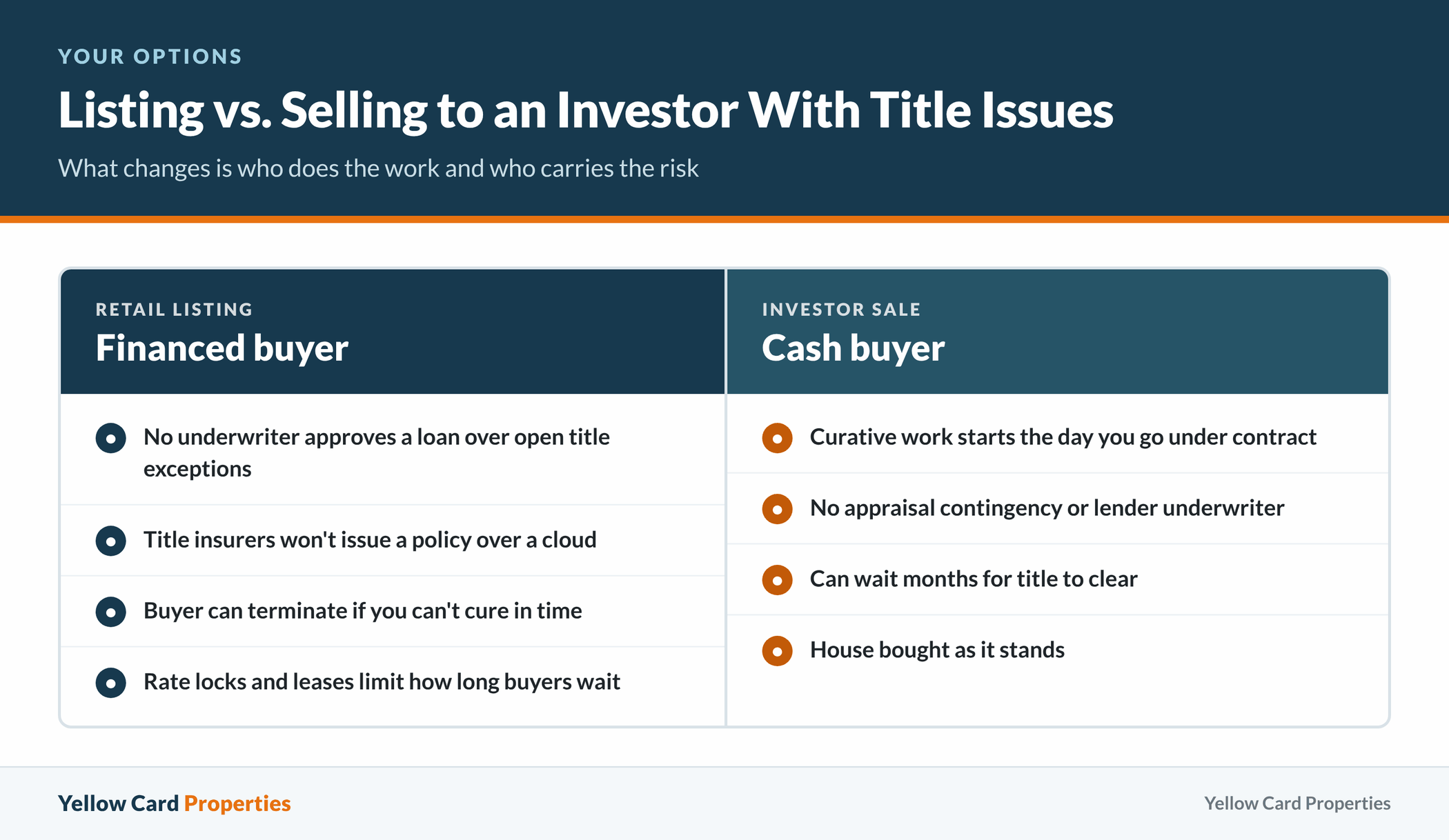
We keep a closing attorney and a title company on retainer, like most seasoned Florida investors. That way curative work starts the day we go under contract, not three weeks into a 30-day escrow. We’ve run quiet title actions, chased lien releases from out-of-state servicers, and paid for probate filings when sellers couldn’t.
Our contracts don’t carry an appraisal contingency, and no lender’s underwriter is second-guessing the title commitment. If the title issues need four months to clear, we can wait. There’s no rate lock running out.
Florida properties tangled in title issues are often vacant, behind on maintenance, and uninsurable as they sit, which pulls them out of the retail market altogether.
A couple in Ocala inherited the wife’s parents’ house a few years back. It came with thirty years of belongings and a garage stacked floor to ceiling with Christmas decorations and boat parts. We handled the heir determination with our attorney and bought it as it stood. The siblings split the proceeds without ever renting a dumpster.
Ask one direct question before you sign with any Florida buyer: who pays if the title work costs more than projected? A straight answer tells you a lot about the company across the table.
Frequently Asked Questions
Can a Homemade Family Deed Cause Title Issues in Florida?
Yes, and it’s one of the most common sources of title issues I encounter. Most family transfers in Florida happen by quitclaim deed or warranty deed. The current owner signs in front of a notary and two witnesses, and then it’s recorded with your county clerk. A quitclaim passes whatever ownership rights you have without guaranteeing them, so a missing witness or a wrong legal description can cloud the title for the next owner. Have a Florida real estate attorney draft any family transfer. If one already happened, order a title search before you list the property.
Can I Sell a House With Title Issues Without a Realtor?
You can. A realtor markets your property and handles negotiation. A title company searches the public records, issues title insurance, holds escrow funds, and prepares the closing documents that transfer legal title. In Florida you can close a real estate transaction without a realtor, though you’ll still want a title company or closing attorney involved so ownership transfers cleanly.
Will Title Insurance Cover Problems That Already Exist?
A title insurance policy covers defects that existed before the policy date but weren’t caught during the search, like a forged deed or an unknown heir who turns up later. Known title issues get listed as exceptions in the commitment, and exceptions are specifically excluded from coverage. That’s why clearing a known defect before closing matters so much. Insurance doesn’t stand in for a cure.
Can I Sell an Inherited Florida Property Before Probate Finishes?
You can sign a contract, but you generally can’t deliver clear title until the court authorizes it. Many Florida investors will go under contract with heirs while probate runs in the background, with closing set for after the court enters its order. Talk to a Florida probate attorney early, because the administration route your estate qualifies for changes the timeline a lot.
What If a Lien Is on My Property From Someone Else’s Debt?
It happens more than you’d think, usually from a name mismatch, where a judgment against a different person with a similar name attaches to your record. Your title company can clear it with an affidavit of identity showing you’re not the debtor. Judgments that truly belong to a prior owner are a different situation and may need negotiation with the lienholder or a court action.
How Long Does a Quiet Title Action Take in Florida?
Expect several months at minimum, and longer if defendants have to be served by publication or anyone contests. Circuit court dockets vary across Florida, so a case in a smaller county may move faster than one in a busy metro. Your attorney can estimate based on local conditions and how many parties need notice.
If you own a Florida property with title issues and can’t decide whether to fix it or sell it, I’m happy to look over your situation. I’ll tell you honestly what I’d do. Sometimes the answer is to hire an attorney and keep the house. Other times it’s to sell and move on. Either way, you can reach out to us at Yellow Card Properties and talk it through with no pressure and no obligation.
Selling a Jacksonville House With Title Problems
Buyers around Jacksonville and St. Augustine have room to negotiate right now. Nearly 44 percent of metro homes sold below asking price in October 2026. A title cloud hands a retail buyer one more reason to push your price down or walk away.
We buy houses from homeowners across Florida with liens, missing heirs and deed errors still on the record. Our closing team starts the title work once you sign, so you don’t have to fix it first.
Get Help With Your Florida Title Issue
If a title problem is holding up your sale, contact Yellow Card Properties and tell us what the search turned up. We can go over your options with you, and you can use the form below to share a few details about the house.